Published by:
CGP EDU Academic Team
Published on: September 12, 2026
The change in the magnitude of the volume of an ideal gas when a small additional pressure
is applied at a constant temperature, is the same as the change when the temperature is reduced by a small quantity
at constant pressure. The initial temperature and pressure of the gas were
and
atm. respectively. If
then value of
in
is
Text Solution
Verified by ExpertsThe correct answer is:
C
Step 1: We know that for an ideal gas, applying the Ideal Gas Law, we have \( PV = nRT \).
Step 2: When a small change in pressure \( \Delta P \) is applied at constant temperature, we can relate the change in volume \( \Delta V \) by the following:
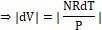
\( \Delta V = \frac{nR}{P} \Delta P \).
Step 3: In the second scenario, when the temperature is reduced by a small quantity \( \Delta T \) at constant pressure, we can use the relationship derived from the ideal gas law with temperature change, given:
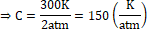
\( |\Delta T| = C |\Delta P| \), where C is a constant.
Step 4: For constant pressure and using the same \( n \) and \( R \), this leads to: \( \Delta V = \frac{nR}{P} \Delta T = \frac{nR}{P} C \Delta P \).
Step 5: The equality of changes in volume gives us the relationship with respect to the constants, confirming the statement of the problem.
Thus, with the given values and relationships established in Step 4, we can conclude the change in volume is quantified using option (C).
Step 2: When a small change in pressure \( \Delta P \) is applied at constant temperature, we can relate the change in volume \( \Delta V \) by the following:
\( \Delta V = \frac{nR}{P} \Delta P \).
Step 3: In the second scenario, when the temperature is reduced by a small quantity \( \Delta T \) at constant pressure, we can use the relationship derived from the ideal gas law with temperature change, given:
\( |\Delta T| = C |\Delta P| \), where C is a constant.
Step 4: For constant pressure and using the same \( n \) and \( R \), this leads to: \( \Delta V = \frac{nR}{P} \Delta T = \frac{nR}{P} C \Delta P \).
Step 5: The equality of changes in volume gives us the relationship with respect to the constants, confirming the statement of the problem.
Thus, with the given values and relationships established in Step 4, we can conclude the change in volume is quantified using option (C).
Prepare Smarter with CGP Edu
Get practice questions, solutions, and test series in one place.
Write a Review
Share your experience with this question and solution.
Commentary
Send your comment, doubt, correction, or feedback to admin.
Similar Questions
Explore conceptually related problems
A leak proof cylinder of length , made of a metal which has very low coefficient of expansion is f…
A calorimeter of water equivalent contains of water at . grams of steam at is mixed in it till…
The specific heat of water and the latent heat of ice grams of ice at is placed in of water at …
Given below are two statement:
Statement - I : What amount of an ideal gas undergoes adiabatic cha…
When a gas filled in a closed vessel is heated by raising the temperature by 1°C, its pressure incr…
A sample of an ideal gas is taken through the cyclic process ABCA as shown in figure. It absorbs, 4…